Scaling Payment Systems for Resilience: The Cloud-Native Advantage

Financial transaction platforms have always operated under a unique set of constraints. Unlike typical enterprise applications, they must handle sustained high transaction volumes, maintain deterministic behaviour under peak load, and remain continuously available even during infrastructure disruption. Historically, these requirements led to large, carefully engineered on-premises environments designed for worst-case demand.
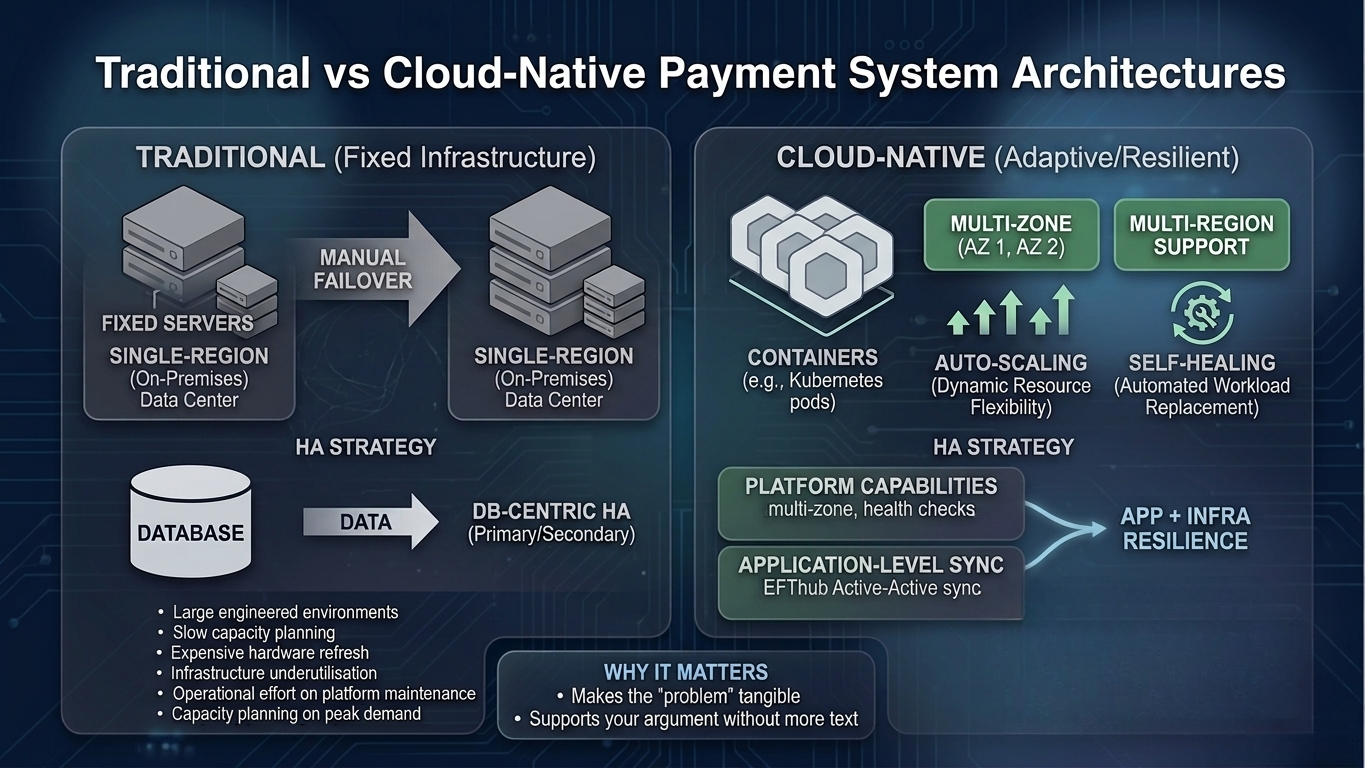
While effective, this model introduce strade-offs: slow capacity planning, expensive hardware refresh cycles, and infrastructure that is often under utilised outside peak periods. More importantly, operational effort is frequently focused on maintaining the platform itself rather than improving the payment services it supports.
From Fixed Infrastructure to Cloud-Native: An Operational Evolution
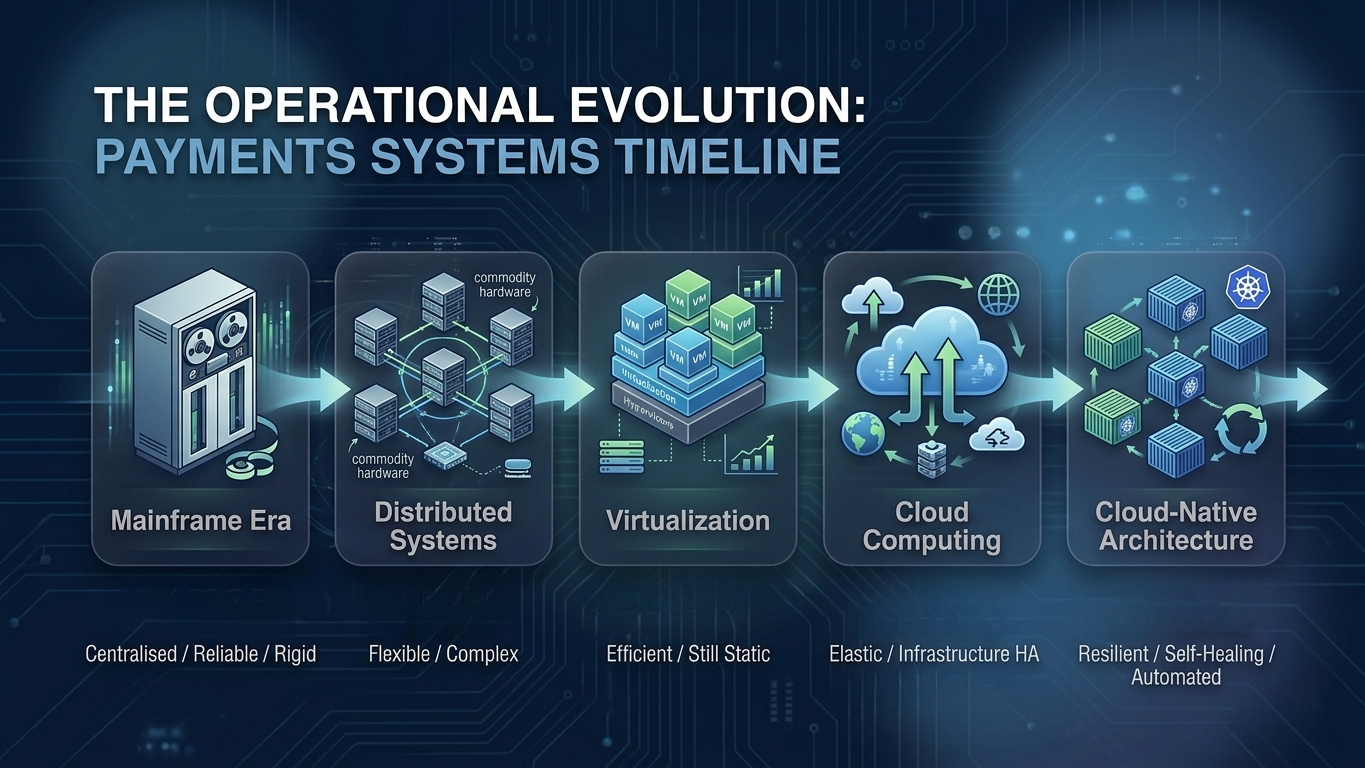
The architecture of payment systems has evolved alongside broader computing trends. Early mainframe environments delivered exceptional reliability and determinism but were inherently rigid and expensive to scale. The move to distributed systems and commodity hardware improved cost efficiency and flexibility, but introduced operational complexity and inconsistency.
Virtualisation improved resource utilisation and simplified provisioning, yet retained a fundamentally static mindset - systems were still sized in advance and scaled slowly. Cloud computing introduced elastic infrastructure, enabling faster provisioning and horizontal scaling, but did not fully address the need for application-level resilience.
Cloud-native architecture represents a further shift: from protecting individual components to designing systems that expect failure and recover automatically. This shift is particularly relevant for payment systems, where continuity of transaction flow matters more than the survival of any single component.
The Limits of Traditional and Cloud Approaches
Traditional on-premises environments require capacity planning based on peak demand, leading to either over-provisioning or risk during unexpected load spikes. Even when deployed in the cloud, systems that rely solely on infrastructure-level availability may still experience disruption if application-level behavior is not designed for resilience.
For payment systems, this distinction is critical. High availability is not only about keeping infrastructure running,but about ensuring that transaction processing remains consistent, recoverable,and observable across failure scenarios.
Why Cloud-Native Matters for Payment Systems
Cloud-native deployment addresses these challenges by combining infrastructure flexibility with application-aware design.
Resource flexibility allows compute, storage, and networking capacity to scale dynamically in response to transaction demand. This enables organisations to handle peak periods more efficiently, avoid long procurement cycles, and allocate headroom for failover scenarios without permanently over-provisioning.
High availability is achieved through a combination of platform capabilities and architectural patterns. Multi-zone deployments, automated health checks, and self-healing workloads reduce the impact of infrastructure failures. However, true resilience comes from integrating these capabilities with application-level strategies that control how transactions are processed and recovered.
Operational management is simplified through standardisation and automation. Infrastructure becomes replaceable rather than irreplaceable, enabling repeatable deployments, consistent upgrades, and centralised monitoring. This allows operations teams to focus more on payment services and less on maintaining individual servers.
Where EFThub Fits
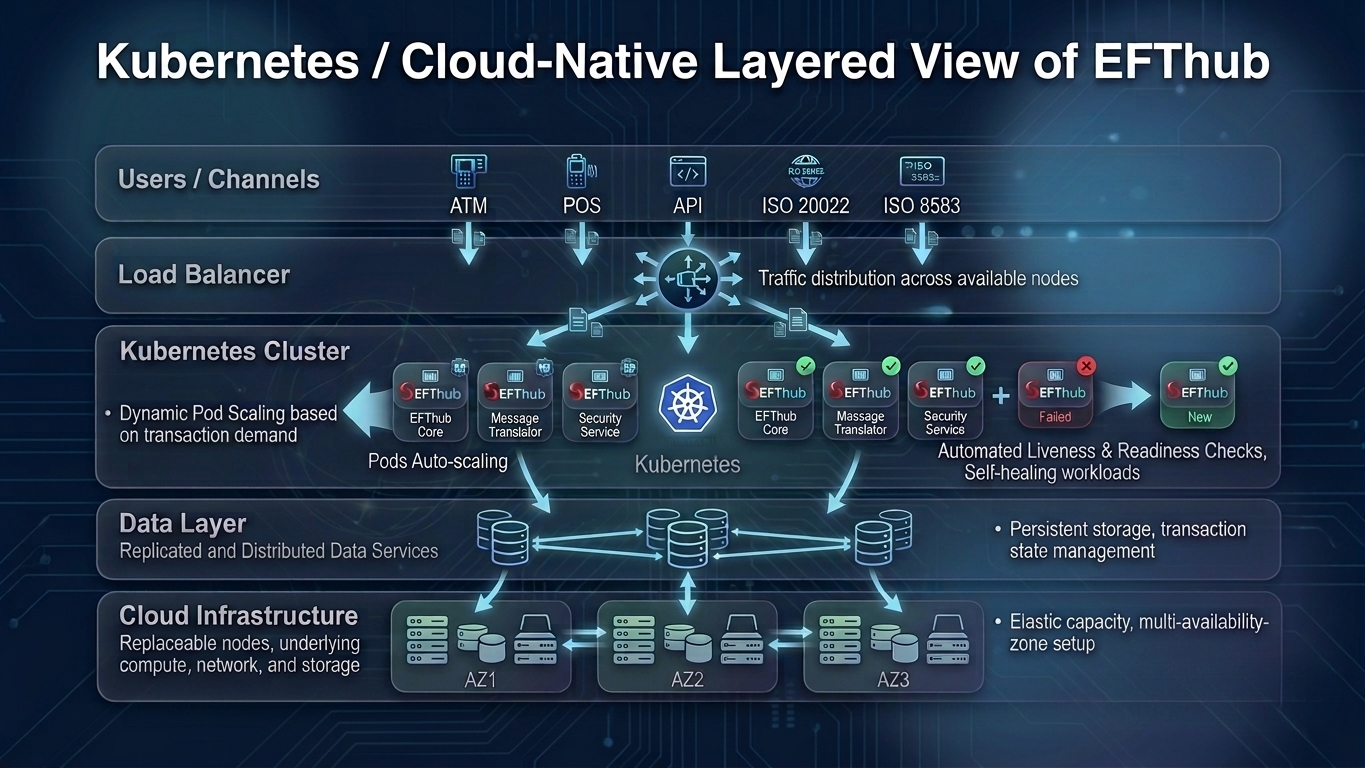
EFThub is designed to operate within this cloud-native model. As an enterprise payment switching platform, it supports high-throughput transaction processing across ATM, POS, API, ISO 20022, ISO8583, and related integration channels.
Its architecture aligns with containerised deployment and orchestration platforms such as Kubernetes, enabling functional separation between processing components, repeatable deployment patterns across environments, and integration with cloud-native services for monitoring,security, and configuration management.
Importantly, EFThub retains the core requirements of payment systems - deterministic processing, auditability, and secure key management - while reducing the infrastructure friction traditionally associated with them.
Active-Active Resilience: Beyond Infrastructure HA
A common limitation in many deployments is an over-reliance on database replication as the primary high-availability mechanism. While cloud providers offer strong intra-region resilience through multi-zone deployments and managed database services, this alone may not be sufficient for the most demanding payment up times.
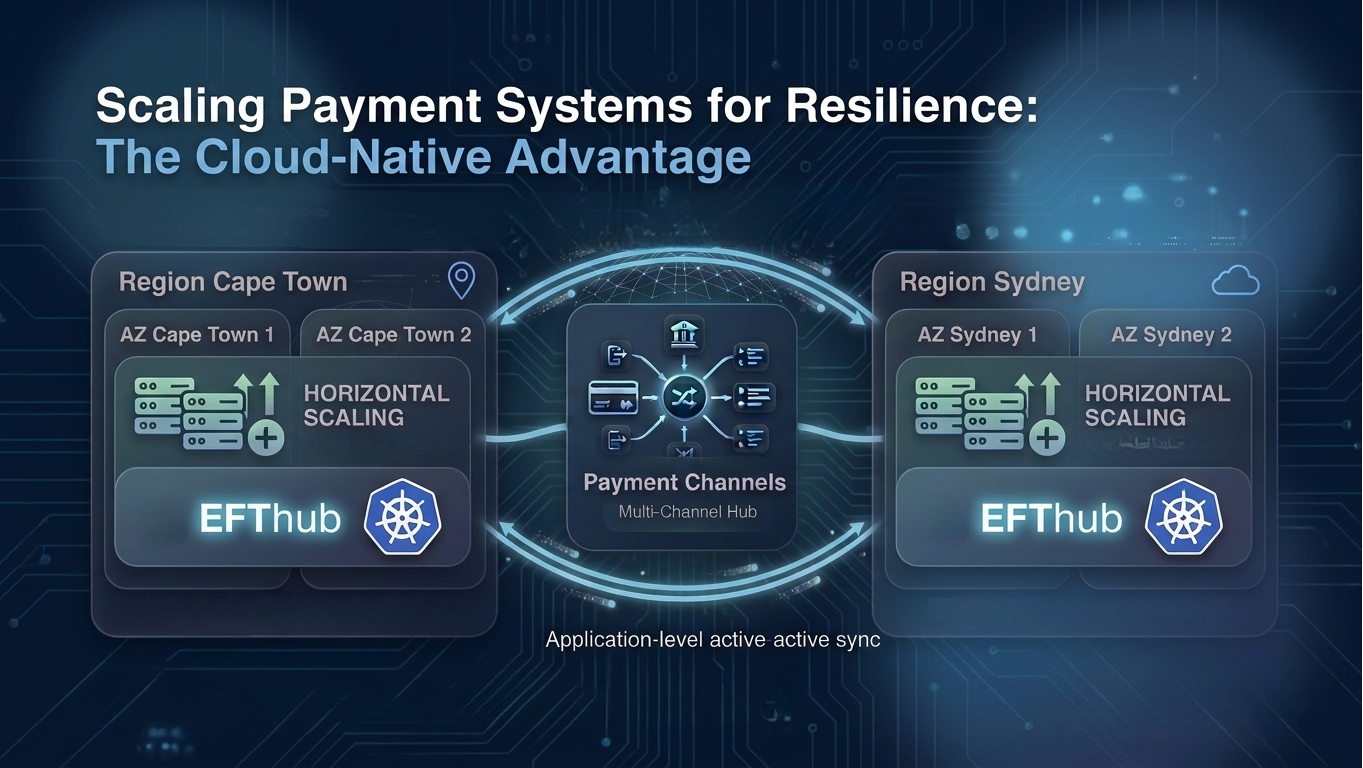
EFThub introduces application-level clustering synchronisation. Independent environments can operate concurrently, each maintaining local persistence while synchronising transaction state and processing logic. This approach distributes responsibility for resilience across both infrastructure and application layers.
The result is a more robust design:infrastructure failures can be absorbed within a region, while cross-region deployments remain operationally independent yet coordinated. This reduces the risk of single-layer failure and provides greater control over failover behavior.
Reference Deployment Patterns
A typical deployment pattern includes a multi-availability-zone setup within a single region, where workloads are distributed across nodes and zones, load balancing manages traffic distribution, and platform services monitor and replace failed components.
For higher availability requirements, this can be extended to a dual-region active-active deployment. Each region operates independently, with EFThub synchronisation providing consistency across environments. This pattern enables resilience not only to component failure,but also to regional disruption.
Operational Benefits and Business Impact
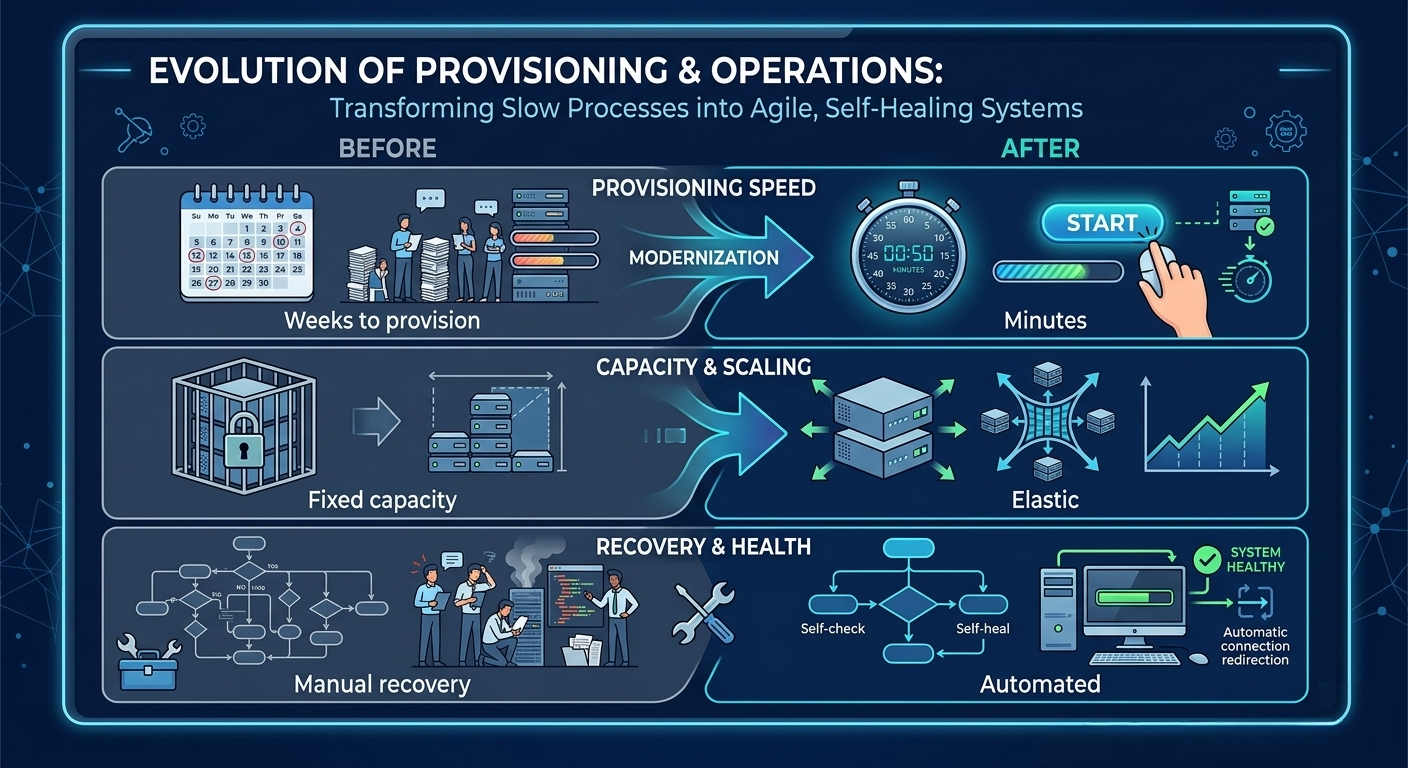
The practical impact of cloud-native deployment is not limited to architectural improvements. Organisations benefit from faster environment provisioning, reduced reliance on specialised hardware,and improved responsiveness to changing transaction volumes.
Elastic scaling allows infrastructure to align more closely with actual demand, reducing wasted capacity while maintaining readiness for peak periods. Automated deployment and management processes reduce operational overhead and improve consistency across environments.
Ultimately, this enables teams to focus on delivering payment services, integrations, and business capabilities rather than maintaining infrastructure.
Conclusion
The evolution of payment systems reflects a broader shift from fixed, infrastructure-centric models toward adaptive, resilient platforms. Cloud-native architecture, when combined with application-level capabilities such as those provided by EFThub, offers a practical path to achieving scalability, flexibility, and high availability.
For organisations operating in demanding transaction environments, this approach represents not just a technological change, but an operational improvement - enabling systems that are easier to scale, easier to manage, and better prepared for failure by design.


